
Chapter 1, free, no email required
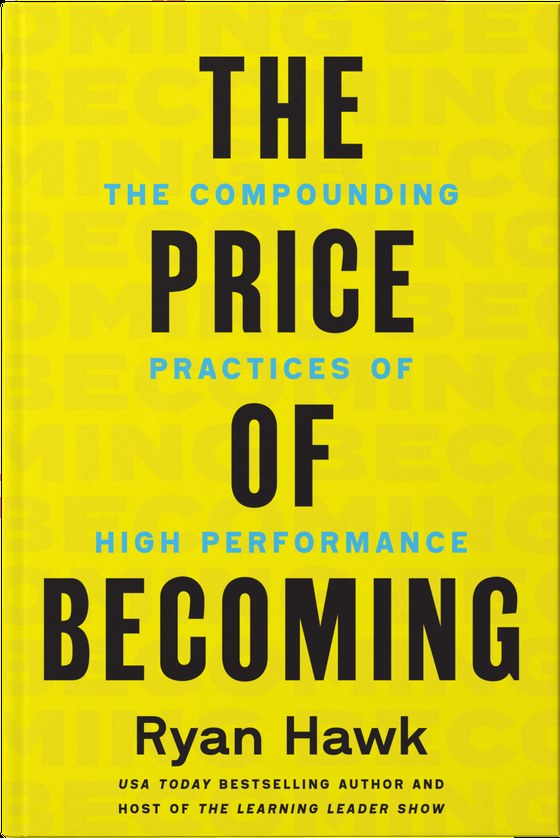
The Price of Becoming
The Compounding Practices of High Performance. Ryan Hawk has recorded more than 700 conversations with the world’s most impactful leaders. Start with the first chapter, in full.
1
Contemplate,
Copy, Create
Building Skills Through Mindful Imitation
Five young, shaggy-haired guys who shared an enthusiasm for American rock-and-roll music decided they wanted to play some songs together in hopes that others would enjoy it. On August 17, 1960, at The Indra Club in Hamburg, Germany, the band played their first gig. At the time, they were a cover band playing songs like “Long Tall Sally” by Little Richard, “Roll Over Beethoven” by Chuck Berry. For the first couple of years of the bands’ existence, they would play marathon sessions sometimes lasting upwards of eight hours. These long sets forced them to expand their repertoire constantly. They’d play the same song multiple times per night, experimenting with different arrangements and developing their signature harmonies. Their lead singer later said these exhausting shows were where they really “got good.”
The turning point came around 1963 into 1964. The band’s producer, George Martin, encouraged them to record their own material, and songs like “I Want to Hold Your Hand” showed they were developing their own style. By 1964’s “A Hard Day’s Night” album, all songs were originals.
Four years of copying, then a voice of their own
1960
Playing covers
First gig at The Indra Club, Hamburg. Eight-hour sets, night after night.
1963–64
Writing their own
George Martin pushes them to record their own material.
1964
All originals
Every song on A Hard Day’s Night.
John Lennon and Paul McCartney wrote songs together as teenagers, even before Hamburg, but they initially considered these efforts amateur compared to their heroes. Yes, The Beatles (who later would slim down to four members after bassist Stuart Sutcliffe left to focus on his painting career), one of the greatest bands of all time, imitated others for years before they had the confidence and ability to find their own voice.
Not only is it common for people to imitate others while they are figuring it out, it’s also useful. We don’t learn how to do the thing by watching others. We learn by doing it. Regardless of what the thing is. It’s natural and helpful to mimic others when we get started. And as we grow and evolve, we mix our unique personalities and style into it and find what makes us, us.
As a new telephonic sales rep at LexisNexis, I initially sat with others in their cubicles to listen to my teammates make calls. Eventually, when I got on the phones, I would mimic (sometimes verbatim) what I heard my colleagues saying. This happened for months before I got comfortable injecting my own personality and flair for how to speak with a prospective customer and sell them our service. As David Perell told me on The Learning Leader Show, “Imitate, then innovate.”
Find Your Own Voice
At some point, you move from imitating and copying others to finding your own voice. Some of the most useful insights come in moments of raw vulnerability. When I talked with Mike Maples Jr., he had lost his father just seven days earlier. The weight of that loss hung in the air as I asked him about the most valuable lessons he learned from his dad.
Mike’s voice carried both the wisdom of his dad and the fresh pain of his absence as he shared: “You don’t know how much time you have in this life. You gotta decide what you wanna do with the gift of your time.”
These words were a son’s reflection on his dad’s legacy, shared during the early days of grief. The truth about honoring the gift of time hits differently when it comes from someone who’s just lost their dad.
Everybody has a unique strand of DNA. No two people are exactly alike. Everyone has an opportunity to be the very best at a certain thing that’s matchable to who they are. A lot of people say, “compete by being THE best.” That’s not the same thing as being your best. It’s understanding what’s the intersection of what you’re passionate about, what you’re good at, and what you can be paid for. And if you do that well, you’re impossible to compete with. You won’t be the best. You’ll be the only. Mike Maples Jr.
In my years of hosting The Learning Leader Show, I’ve noticed that the guests who’ve made the biggest impact aren’t necessarily the ones with the most impressive resumes. They’re the people who’ve fully embraced their authentic selves and built their excellence on that foundation.
The No-Comfort Zone
Growth is uncomfortable. It has to be because real growth means leaving behind something familiar, something safe. Staying comfortable isn’t neutral. It’s actually a decision to stop growing.
There’s a great scene from the TV show Boy Meets World that captures this idea perfectly. The main character, Cory Matthews, is in the garden with his wise teacher, Mr. Feeny, worried about his girlfriend, Topanga, possibly moving away. Cory doesn’t like change. He wants things to stay the same. Feeny listens, then points to a flower and says: “See that flower? That flower was in a small pot in my living room, but it outgrew its surroundings, so I transplanted it here in the garden.”
Cory responds, “Seems like it’s doing okay.”
Feeny nods. “Oh yes, it’s flourishing . . . Now when I pulled the small flower out of the pot in my living room, it resisted a little, you know, tried to hang on by its roots. I had to force it out.”
Cory asks, “Because you thought it would do better out here, in the world, right?”
Feeny corrects him: “No. Because I thought if I left it there, it would stop growing.”
Staying in the pot feels good until you realize the walls are keeping you small.
Cory feared that if Topanga moved, everything would fall apart. But Feeny’s lesson wasn’t just about a flower. It was about people, about how change, even when it feels forced on us, is often the very thing that allows us to grow.
Moving to something bigger often requires being pulled away from what’s comfortable. But eventually, you’ll look back and realize the discomfort wasn’t punishment; it was necessary.
Gretzky’s Office
The greatest hockey player of all time started with what many would consider a disadvantage: he was smaller than most hockey players. This is a story about adaptation. And it teaches us something useful that we often miss.
Wayne Gretzky wasn’t the biggest or strongest player on the ice. In a sport dominated by physical play, this could have been a career-limiting issue. The traditional path would have been clear: bulk up, get stronger, learn to take the hits. That’s what most people would have done.
But Gretzky took a different approach. From a young age, he became a student of the game. As his father Walter described, young Wayne would sit in front of the TV watching hockey games with remarkable focus. Bobby Clarke of the Philadelphia Flyers was one of the players Gretzky studied intensely. Clarke wasn’t the biggest player either, but he dominated through intelligence and positioning.
Gretzky would often have a notebook out, tracking the movement of players like Clarke and the puck, and look for patterns that others missed. His father recalled how Wayne would draw diagrams of the rink, mapping out where players positioned themselves during different situations in the game.

He noticed two things that would change hockey forever: skilled players like Clarke used the corners of the rink to their advantage, and the space behind the net was virtually unused territory.
Instead of trying to fix his weakness (his size), Gretzky redirected it. He turned the net into a shield rather than a target. He established what became known as “Gretzky’s office,” the area behind the net where he could control play. He played where others didn’t think to play.
Gretzky didn’t win by becoming someone else. He succeeded by studying the game deeply enough to find his own path through it. He didn’t fight physics; he found a different way to use it. Sustainable advantages are built by finding ways to make those weaknesses irrelevant.
The next time you’re faced with a limitation, remember that sometimes the best solution isn’t to overcome it, but to redirect it. Gretzky’s story is about the power of observation and the importance of finding your own game.
This principle extends far beyond sports. In business, you might lack the capital of established competitors, but you can create systems with fewer layers of approval that let you move faster. In careers, you might not have elite credentials, but you can build unique combinations of skills that no specialized expert possesses. In education, you might not have access to prestigious institutions, but you can develop self-directed learning habits that outpace traditional curricula. The pattern is the same: don’t just play the same game better; find the part of the game others ignore. Create your own office.
The Courage to Seek Greatness
Timothée Chalamet’s 2025 Screen Actors Guild Best Actor acceptance speech for his portrayal of Bob Dylan in A Complete Unknown was all about authentic ambition. Instead of downplaying his efforts with false modesty, he acknowledged the truth: “This was five and a half years of my life. I poured everything I had into playing this incomparable artist.”
What makes his speech so refreshing is his unapologetic declaration of purpose: “I’m really in pursuit of greatness. I know people don’t usually talk like that, but I want to be one of the greats.” By openly citing his inspirations from Daniel Day-Lewis and Viola Davis to Michael Jordan and Michael Phelps, Chalamet revealed the driving force behind his dedication.
We live in an era where performative nonchalance often masks genuine effort. This tendency to appear effortlessly successful creates a paradox: we admire achievement but scorn the visible striving required to reach it. Maybe this contradiction serves as a safety net. If we act like we didn’t try that hard, rejection feels less personal.
But there’s something so inspiring about those who, like Chalamet, embrace their ambitions without apology. They understand that greatness rarely happens by accident. It requires commitment, vulnerability, and the willingness to fail publicly in pursuit of something meaningful.
The brevity of his speech only amplified its impact. In recognizing his award not as validation but as “a little more fuel . . . a little more ammo to keep going,” he showed that true ambition is about the internal drive to continuously evolve and excel.
We should all take a page from Chalamet’s playbook, acknowledging our efforts, embracing our ambitions, and understanding that while winning isn’t guaranteed, the pursuit itself has intrinsic worth. The value is in who you become through the process of dedicated, intentional striving. When’s the last time you admitted to someone what your real ambitions are? How often do you downplay your efforts to avoid seeming too eager, too invested? What would change if you stopped apologizing for wanting something badly?
The Prison, or Potential, of Self-Belief
Few things have more influence on our outcomes than the narrow circle we draw around our potential. Most people will not venture beyond what they already think they can do. We tend to achieve almost exactly what we already decided was achievable.
This shows up everywhere. The student who “isn’t good at writing” turns in mediocre essays because that’s what they expected from themselves. The employee who believes they’ll never make management doesn’t pursue the experiences that would qualify them for a management position. Someone convinced they can’t speak publicly avoids all opportunities to practice and get more comfortable. When you believe something about your abilities, you unconsciously adjust your actions to make that belief come true.
Consider the story of a sixty-one-year-old Australian potato and sheep farmer, Cliff Young, who showed up to the 1983 Sydney to Melbourne ultramarathon wearing overalls and work boots. The veteran runners laughed. Experts said completing the 543-mile race required running for eighteen hours and sleeping for six, a strategy all professional runners followed. Young, with no preconceptions about what was possible, ran at his own shuffling pace, hardly sleeping for five and a half days. He not only finished but won by a lot, breaking the previous record by nearly two days. What the professionals “knew” to be impossible blinded them to a superior approach. Young hadn’t learned what couldn’t be done.
A barrier is a belief until somebody crosses it
For years
Beyond human capacity
Nobody had ever run a mile in under four minutes.
May 6, 1954
3:59.4
Roger Bannister
- Within weeksothers followed
- Within yearshundreds had done it
The four-minute mile offers another classic example. For years, running a mile under four minutes was considered beyond human capacity. Roger Bannister finally broke it in 1954. Within weeks, others followed. Within years, hundreds had done it. The primary limitation wasn’t physical. It was a collective agreement, a belief system, about where the boundary of human performance should be. Expectations can be a powerful thing. And so can confidence and belief in oneself. When Bannister stepped onto that track, he was carrying the quiet certainty that what everyone called impossible was just untested. His four-minute mile broke a false story that hundreds of other runners had been telling themselves. The funny thing about mental barriers is they’re often the strongest ones we face, and the easiest ones to break once someone shows it can be done.
This works in both directions. The person who believes they’ll fail takes fewer risks and creates fewer opportunities for success. The person who believes achievement is possible seeks out situations where achievement becomes probable.
Reflection Questions
- Who do you most admire, and what specifically about their approach could you study and practice for the next thirty days?
- What three things do you believe you “can’t do” or “aren’t good at” that might actually be self-imposed limitations rather than real boundaries?
- Looking at your current challenge or weakness, how could you redirect it rather than trying to overcome it directly? What would your “office behind the net” look like?
- What’s the intersection of what energizes you, what you’re naturally good at, and what people would pay you for? Be specific.
- What ambitious goal are you embarrassed to say out loud, and why does admitting your pursuit of greatness feel uncomfortable?
Take Action
- Find someone worth copying, then copy them relentlessly. The fastest way to get good at anything is to study someone who’s already figured it out. Pick one person whose work you respect. For the next thirty days, imitate their methods exactly. Don’t try to be original. Originality comes later, after you understand the basics.
- Carry a notebook everywhere. Most people go through life half-asleep. They miss the small moments that contain big insights. Start writing down things you notice each day that other people ignore. The person who pays attention to details that others miss will have an advantage.
- Answer three questions honestly. What makes you lose track of time? What do people consistently ask for your help with? What would you do for free because you enjoy it that much? The intersection of these three answers is where you’ll find work that feels like play.
- Start using your weaknesses. Everyone has limitations. Most people waste energy trying to fix them. Smart people figure out how to make their weaknesses irrelevant. If you’re not a natural public speaker, become the go-to person for one-to-one client relationships or written communication.
- Study fields that have nothing to do with yours. The best ideas come from combining insights from different areas. A biologist studying economics might discover something neither pure biologist nor pure economist would see.
- Question what you think you can’t do. Most of your limitations exist only in your head. Write down three things you’ve always believed you’re bad at. Then do one small thing this week to test whether that’s actually true.
- Own your ambitions. Pretending you don’t care about success won’t protect you from failure, but it will guarantee mediocrity. Tell someone what you’re actually trying to accomplish. Say it out loud.
That’s Chapter 1.
Chapter 2 is called Curiosity Compounds. It opens on a cool March morning in New York, lost on the way to meet Brian Koppelman. Enter your email and I’ll send it straight to your inbox.
One email, no spam, unsubscribe any time.
The Price of Becoming
Nine chapters on how high performers learn, work, and lead. Out now.




