
My new book, The Price of Becoming, is now available for pre-order. To learn more about all of the pre-order bonuses (it’s worth it), CLICK HERE.
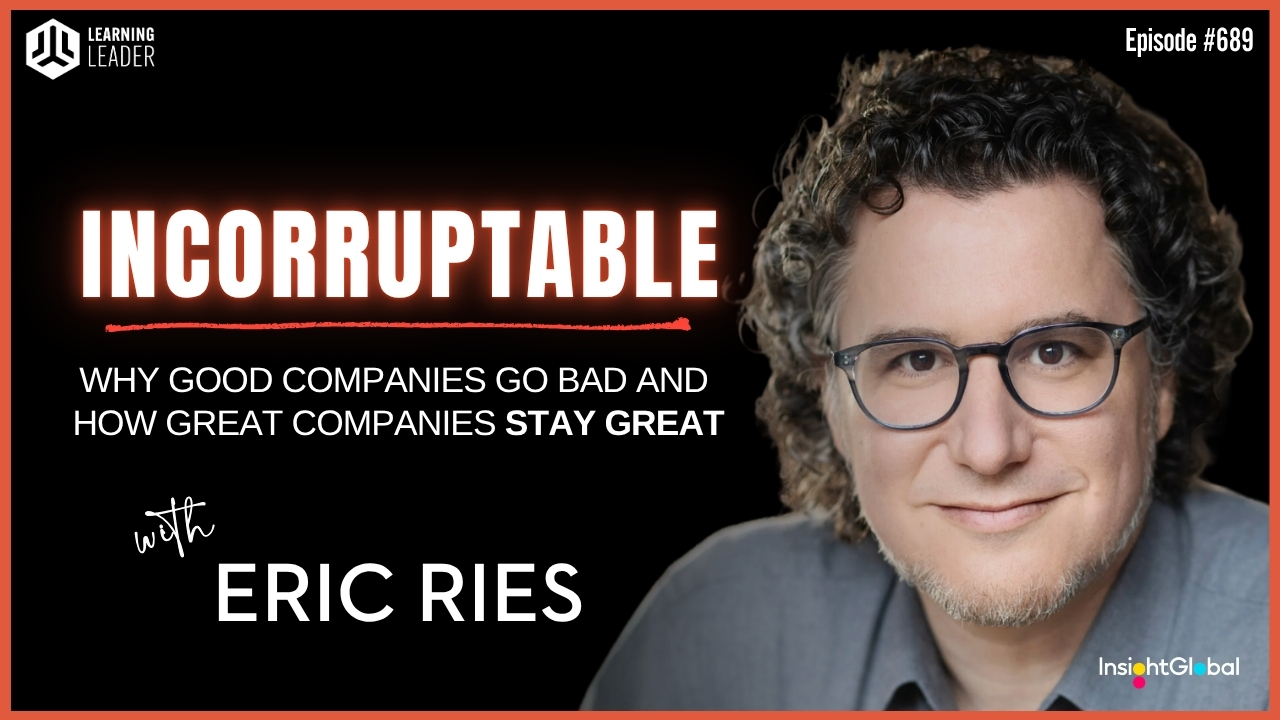
Eric Ries is the author of The Lean Startup, one of the most influential business books of the past 25 years, and the founder of the Long-Term Stock Exchange, the first new U.S. exchange to both list and trade multiple stocks since NASDAQ launched 50 years ago. His new book is Incorruptible.
You can WATCH our conversation on YouTube.
This is brought to you by Insight Global. If you need to hire one person, hire a team of people, or transform your business through Talent or Technical Services, Insight Global’s team of 30,000 people around the world has the hustle and grit to deliver.
Be part of “Mindful Monday” — Text Hawk to 66866
Key Learnings
The more successful a company becomes, the more valuable it is as a target. Companies are worth stealing and taking over. Some founders are naive about this and don’t understand what’s coming for them. They’ve been following the so-called best practices about how companies should be built, structured, and governed.
Sol Price was a lawyer before he became an entrepreneur. He believed a lawyer had a fiduciary duty to put the client’s interests before his own. So when he became a retailer, he asked: “Who’s my client?” The customer. He treated the customer as the person he would rather die than betray. When competitors sold a product for less, he’d put up signs in his own store: “Don’t buy this from me. You can get it cheaper somewhere else.” He capped his margins at 14 percent. He paid above-market wages.
It is easier to destroy than to create. One day, Sol came into work and couldn’t get into his office because the locks had been changed. Investors had pushed him out and forced Fedmart to practice retail best practices. Within seven years, they bankrupted the company. We’ve built an economy that rewards people for cost-cutting without holding them accountable for the consequences to trustworthiness, brand, or culture.
The origin story of Costco: Sol took two weeks off, then leased the office upstairs from Fedmart and started Price Club. One of the young guys who left with him, Jim Sinegal, had worked his way up from stock boy. Jim eventually started his own company using the Sol ethos. A few years later, their companies merged to form what we now call Costco.
Wall Street routinely calls Costco the exception to every rule. Wall Street analysts say things like: “At Costco, they take money that rightfully belongs to shareholders and instead invest it in the customer experience.” As if that’s a criticism. Costco endures because it’s protected by a governance fortress. A series of worst practices that resist outside pressure structurally.
The $1.50 hot dog has been the same price since 1986. A McDonald’s Big Mac was $1.60 in 1986. Today, that same Big Mac in California is over $7. Costco sells more hot dogs than every Major League Baseball stadium in America combined. If they raised the combo to $7, it would be a billion dollars of extra net income. They could do it. They choose not to.
“If you raise the price of the effing hot dog, I will kill you. So figure it out.” Jim Sinegal said it to his COO in 2008 when costs were rising. Figure it out. Costco vertically integrated the hot dog supply chain. They own hot dog production plants in multiple cities. They worked deals with soda vendors. They did all that extra work for the privilege of not making more money on the hot dog.
Harder is easier. “When you take the hard road, when you make a principled commitment, you get these almost unbelievable values. Because you’re generating the most underrated and most valuable asset in all of business: trustworthiness.”
“Easy choices, hard life. Hard choices, easy life.” Jerzy Gregorek, Olympic weightlifter.
“Everybody wanna be a bodybuilder. Nobody wanna lift these heavy ass weights.” Ronnie Coleman, eight-time Mr. Olympia. Everyone wants the outcome. Nobody wants to do the actual thing.
Culture and mission can be cultivated, not commanded. Most leaders get this wrong. They say “I’m in charge of my team.” But can you command your team to have integrity? Can you command it to have a particular culture? You have to make consistent, responsible choices, just like cultivating health in your body.
Get reps. Eric gave practice talks at a Hobee’s restaurant at 7 AM to six people just to get the reps. Caring and trying to do a good job is so unbelievably rare. That alone is a competitive advantage.
Feedback tells you something about the person giving it, not about yourself. If someone reads Eric’s manuscript and says, “This book sucks,” he hasn’t learned anything about the book. He’s learned this person doesn’t like this kind of book. When he stopped arguing with negative customer reviews and started studying who they came from, he noticed patterns. People 16 and younger loved the product. People 16 and older hated it. He learned who his product was for.
Separate qualitative from quantitative feedback. Qualitative is for hypothesis generation. Quantitative is for hypothesis validation. When test readers told him a chapter wasn’t working, that was qualitative. When the platform data showed nobody was getting past that chapter, that was quantitative. You need both to know what to fix.
It is always too early until it’s too late. Eric tells the story of a multibillion-dollar founder he warned before his IPO. The founder talked to his bankers, lawyers, and CFO. They told him Eric was a downer. The founder went public anyway with conventional governance. Five months later, his stock dropped 90 percent, and he was ousted. The best time to plant a tree is 40 years ago. The second-best time is today.
Eric’s checklist for building an incorruptible company:
- Encode your mission into the corporate charter. Most founders have never read their charter. If your mission statement says one thing but your legal charter says another, you’re lying. The easiest fix: file a public benefit corp filing (PBC). Two pages. 44 states. Your lawyer can do it tomorrow.
- Identify your fiduciary commitments. Who would you rather die than betray? Is it your customers? Your employees? Product quality? You decide. If your answer is nobody, you’re a sociopath. The whole book is for the people who actually want to accomplish something.
- Align your employees to that mission. Make sure everybody on the team is committed to the same fiduciary priority.
- Create a director’s oath. Like the Hippocratic Oath for doctors, but for your board. They must pledge to commit to the company’s mission. Board betrayal and investor pressure are leading causes of death of companies in the modern world.
- Make the directors accountable to somebody. Power without accountability is corrosive to the human spirit. Novo Nordisk is governed by a nonprofit foundation. Patagonia is governed by a perpetual purpose trust. John Lewis Partnership in the UK is governed by an employee ownership trust. IKEA, Vanguard, and REI all have these structures. The data shows these companies are dramatically more stable and higher performing than conventional structures.
You are not stuck in traffic. You are traffic. People love to blame the system. But you’re not just a passenger. You’re part of what creates the system. Where you work. What you buy. What you give your attention to. Every one of those choices is fueling somebody’s company, somebody’s algorithm, somebody’s bonus. The richest people in the world spend billions on PR because they know your individual choices matter. Use that power.
Eric’s champagne moment a year from now: a grassroots movement around Incorruptible. This book won’t get wall-to-wall media coverage. It’s antagonistic to people in power. So Eric hopes readers will hand it to their founders, their bosses, their friends. If consumers and employees start demanding, “I want to work in an incorruptible company,” that’s the toast.
Reflection Questions
- What is your equivalent of Costco’s hot dog? The one commitment you’d defend even when it’s financially painful, even when the easy move would be to abandon it?
- Have you ever read your corporate charter, or the foundational document of your team or department? Does what’s actually written match what you say you stand for?
- Where in your work or life would the harder short-term path build something more durable in the long run? Are you willing to lift the heavy weights?
More Learning
#258: Jesse Itzler: Creating Your Life Resume & Living Outside the Box
#529: James Clear: Setting Up Your Future Self & Becoming an Optimist
#565: Noah Kahan: The Art of Asking For What You Want
Podcast Chapters
00:00 The Price of Becoming – Pre-Order Now!
01:03 Meet Eric Ries
02:55 Is It Possible to Build an Incorruptible Company?
04:04 Why Culture Alone Won’t Save You
05:13 Sol Price, Fedmart, and the Locks That Got Changed
07:56 Why Wall Street Calls Costco the Exception
09:11 The $1.50 Hot Dog Story
13:59 Harder Is Easier: The Principle Behind It All
16:48 Why Governance Is Just Soul Craft
19:50 Building the First New Stock Exchange Since Nasdaq
22:33 Eric’s Communication Style: Reps, Not Talent
30:52 The Opportunity Hiding in Broken Markets
31:59 How to Know Which Feedback to Listen To
35:39 Qualitative vs. Quantitative: Why You Need Both
37:23 The Whole Foods Cautionary Tale
40:25 The Founder’s Checklist for Building Something Durable
43:44 Encode Your Mission Into the Corporate Charter
47:35 You Are Not Stuck in Traffic. You Are the Traffic.
52:37 The Champagne Question: A Grassroots Movement
55:27 James Clear, Author’s Equity, and the Future of Publishing
56:43 EOPC
Leave A Comment